Is Hernia a Chronic Disease? Understanding Recurrence, Long-Term Outcomes, and Follow-Up
A ventral hernia is often viewed as a condition that can be permanently corrected with surgery. However, growing evidence suggests that some patients may continue to experience recurrence, chronic pain, functional limitations, or other complications years after ventral hernia repair.
This raises an important question: Should ventral hernia be considered a chronic condition requiring long-term monitoring rather than simply a one-time surgical problem?
Long-term research has highlighted limitations in how hernia repair outcomes are traditionally measured. Recurrence is frequently reported within the first few years after surgery, while complications that develop later may receive less attention.
Understanding these long-term outcomes can help patients and healthcare professionals have more informed discussions about ventral hernia repair, recurrence risk, follow-up, and treatment options.
Table of Contents
What Is a Ventral Hernia?
A ventral hernia occurs when tissue pushes through a weakened area of the abdominal wall. Ventral hernias can develop naturally or occur at the site of a previous abdominal surgical incision, in which case they are commonly referred to as incisional hernias.
Treatment depends on factors such as the size and location of the hernia, symptoms, previous abdominal operations, overall health, and risk of complications.
For patients who undergo surgery, the immediate goal is to repair the abdominal-wall defect and restore function. But long-term outcomes are also important because recurrence and other complications can occur after the initial recovery period.
How Common Is Ventral Hernia Repair?
Ventral and incisional hernias are frequently treated by general surgeons. More than 350,000 ventral hernia repair procedures are performed annually in the United States.
Despite the number of procedures performed, research has historically placed considerable emphasis on relatively short follow-up periods.
A repair may be evaluated at one or two years, with recurrence reported as either present or absent.
The problem is that a patient can develop a recurrence or other complication several years after surgery.
What Does Long-Term Research Show About Ventral Hernia Repair?
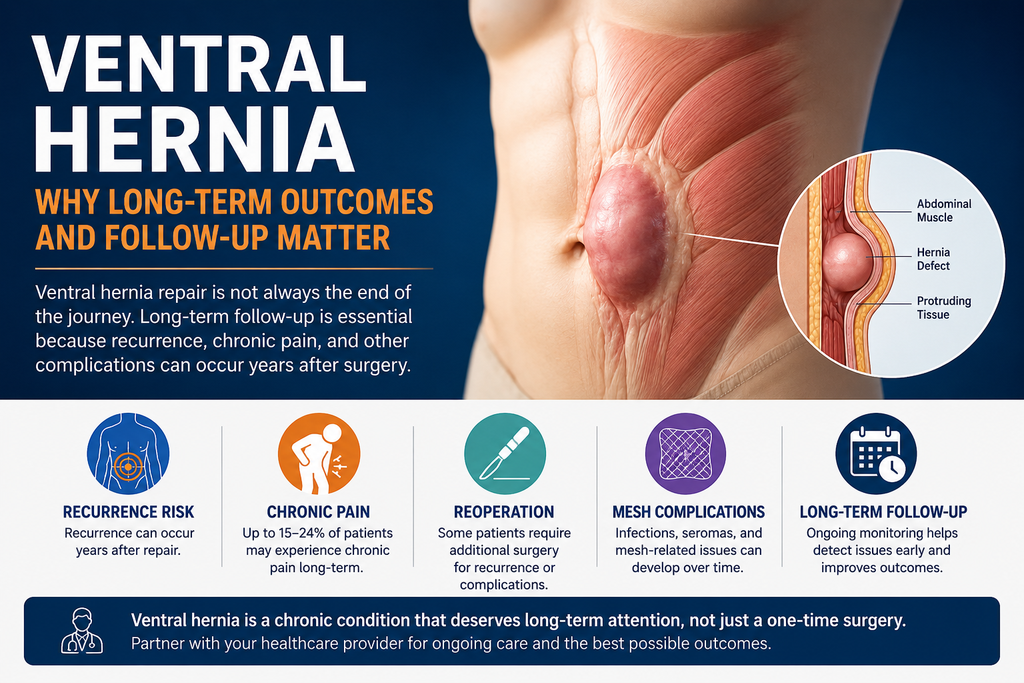
A 2025 systematic review and meta-analysis examined 22 studies involving 2,721 patients with at least five years of follow-up.
The pooled recurrence rate was approximately 13%. In some individual cohorts with follow-up extending beyond five years, recurrence rates reached as high as 50% among patients who did not receive mesh.
The review also reported:
- 15% chronic pain overall
- 24% chronic pain in studies with at least 10 years of follow-up
- 8% reoperation
- 11% seroma
- Approximately 2% mesh infection
Mesh infection may require removal of the mesh and can lead to additional wound complications and prolonged recovery.
These findings demonstrate why long-term follow-up can provide information that is not visible in short-term surgical studies.
Why Can Ventral Hernia Recurrence Happen Years Later?
A successful initial repair does not guarantee that a hernia will never recur.
Recurrence can develop years after surgery. Other problems, including chronic pain and mesh-related complications, may also become apparent later.
This means that the absence of a recurrence during the first postoperative year does not necessarily predict the patient’s outcome five or 10 years later.
For this reason, long-term studies are important when evaluating the durability of different ventral hernia repair techniques.
Why Short-Term Follow-Up May Not Tell the Whole Story
Some studies report relatively low recurrence rates during the first year following surgery.
For example, a study of laparoscopic ventral hernia repair reported a 6% recurrence rate at 12 months. A separate meta-analysis of the Rives-Stoppa technique reported a 3.2% recurrence rate at 12 months among more than 12,440 patients.
These findings may accurately describe the period that was studied.
However, they do not necessarily tell us what will happen to those patients several years later.
The distinction is important because hernia recurrence can occur long after the initial repair.
The Challenge of Long-Term Hernia Follow-Up
Long-term follow-up can be difficult in hernia research.
One study included in the systematic review retained only 41.6% of its original patient population for long-term follow-up. Consequently, outcomes for a substantial proportion of the original participants were unknown.
This creates a potential source of attrition bias.
Patients may change healthcare providers, move to another location, receive treatment at another institution, or simply stop participating in follow-up programs.
As a result, researchers may not capture every recurrence or complication that develops after surgery.
What Outcomes Matter Beyond Recurrence?
A successful ventral hernia repair should not necessarily be judged only by whether the abdominal-wall defect has returned.
Patients may also experience:
- Chronic pain
- Functional limitations
- Reduced physical activity
- Cosmetic concerns
- Anxiety about recurrence
- Mesh-related complications
- Seroma
- Additional surgical procedures
- Changes in quality of life
Validated patient-reported outcome tools—including HerQLes, Abdominal Hernia-Q, EuraHS, and the Carolinas Comfort Scale—can help researchers and clinicians assess some of these patient-centered outcomes.
However, the source literature indicates that patient-reported outcomes have not been consistently collected beyond the first one or two years following surgery.
What Is Ventral Hernia Recurrence?
Ventral hernia recurrence occurs when a hernia returns after previous repair.
However, not every recurrence has the same clinical significance.
For example, an asymptomatic recurrence discovered during imaging is very different from a recurrence associated with bowel obstruction, strangulation, bowel ischemia, or another emergency.
Reporting both situations simply as “recurrence” does not communicate the full clinical picture.
A standardized recurrence classification can provide more useful information about the severity and consequences of recurrence.
A Proposed Ventral Hernia Recurrence Grading System
A classification system proposed by Salvatore Docimo Jr., DO, and Diego Lima organizes recurrence according to symptoms, treatment requirements, and clinical severity.
Grade 0 — No Recurrence
There is no evidence of hernia recurrence.
Grade IA — Asymptomatic Recurrence
A recurrence is identified by a surgeon or through imaging, but the patient has no complaints and surgical intervention is not indicated.
Grade IB — Patient-Reported Asymptomatic Recurrence
The patient reports a recurrence, but it is asymptomatic and does not require surgical intervention.
Grade IIA — Symptomatic Recurrence Managed Without Surgery
The recurrence produces symptoms but can be managed through observation or watchful waiting.
Grade IIB — Symptomatic Recurrence Requiring Elective Repair
The recurrence causes symptoms and elective surgical repair is indicated.
Grade III — Symptomatic Recurrence Requiring Urgent Surgery
The recurrence requires urgent surgical treatment but does not involve a life-threatening complication.
Grade IV — Life-Threatening Recurrence
The recurrence causes a life-threatening complication requiring emergency surgery. Examples include:
- Strangulation
- Bowel ischemia
- Bowel obstruction
- Perforation
- Abdominal compartment syndrome
- Septic shock
Grade V — Death Related to Recurrence
Death occurs directly as a result of a complication associated with the recurrent hernia.
Grade VI — Death Unrelated to Recurrence
The patient dies from a cause unrelated to the hernia recurrence.
The proposed classification is designed for different types of ventral hernias and surgical approaches, including open, laparoscopic, and robotic procedures.
Why Standardized Hernia Recurrence Grading Matters
Standardized terminology could improve communication between clinicians and make research studies easier to compare.
Consider two patients who both have a recurrent ventral hernia.
One patient has an asymptomatic recurrence discovered on imaging and requires no treatment.
Another develops bowel obstruction and requires emergency surgery.
Both technically have a recurrence, but the clinical severity is dramatically different.
A graded classification makes this distinction easier to communicate.
The proposed system follows a broader principle already used in surgical medicine: complications can be categorized according to their severity and the level of treatment required.
For hernia research, this could improve outcome comparisons, quality benchmarking, clinical communication, and patient counseling.
Should Ventral Hernia Be Considered a Chronic Disease?
The authors of the referenced research propose reconsidering ventral hernia as a chronic disease.
The argument is based on the long-term nature of the condition.
A ventral hernia can persist for years, recurrence can occur long after repair, chronic pain may develop or continue, and mesh-related complications can become apparent after the initial postoperative period.
At the same time, structured long-term surveillance is not routinely part of care for every patient following ventral hernia repair.
This does not mean that every patient will experience long-term complications. Rather, it highlights the importance of recognizing that hernia repair outcomes can extend far beyond the initial surgical recovery period.
The Potential Role of Specialized Hernia Centers
The increasing complexity of abdominal wall reconstruction has also raised interest in specialized hernia centers.
Modern ventral hernia surgery can involve advanced mesh materials, component separation procedures such as transversus abdominis release, robotic surgery, and individualized optimization of patients with higher surgical risk.
Specialized centers may be able to provide:
- Dedicated abdominal-wall expertise
- Multidisciplinary care
- Structured long-term follow-up
- Prospective patient registries
- Consistent outcome measurement
- Management of complex and recurrent hernias
- Access to advanced abdominal-wall reconstruction techniques
High-volume centers may also be better positioned to collect long-term data and study late recurrence patterns.
What Could Improve Long-Term Ventral Hernia Care?
Several changes could make the evaluation and management of ventral hernia more comprehensive.
Longer Follow-Up
Research should continue evaluating patients beyond the first one or two years after surgery, including five- and 10-year outcomes where feasible.
Standardized Recurrence Definitions
Consistent definitions can make outcomes easier to compare between studies and healthcare institutions.
Patient-Reported Outcomes
Pain, physical function, quality of life, and patient satisfaction should be considered alongside anatomical recurrence.
Prospective Registries
Large prospective databases may help identify long-term patterns that shorter studies cannot detect.
Specialized Care
Patients with complex, recurrent, or high-risk hernias may benefit from consultation with surgeons who have specialized abdominal-wall expertise.
What Should Patients Ask Their Healthcare Professional?
If you have a ventral or incisional hernia, consider discussing questions such as:
- What type of hernia do I have?
- Does my hernia require surgery?
- What are my treatment options?
- What is my individual risk of recurrence?
- Could I experience chronic pain after repair?
- What type of repair is being recommended and why?
- Will mesh be used?
- How long should I expect to be followed after surgery?
- What symptoms should prompt me to seek urgent medical attention?
- Should I be evaluated by a specialist in complex abdominal-wall reconstruction?
Your healthcare professional can answer these questions based on your individual anatomy, medical history, surgical history, symptoms, and risk factors.
The Bottom Line
Ventral hernia repair can be an effective treatment, but the patient’s outcome should not necessarily be judged only by what happens during the first postoperative year.
Long-term evidence indicates that recurrence, chronic pain, reoperation, seroma, and mesh-related complications can remain relevant years after surgery.
This has prompted researchers to argue for longer follow-up, more standardized definitions of recurrence, greater use of patient-reported outcomes, and potentially more specialized approaches to long-term hernia care.
The concept of ventral hernia as a chronic condition does not mean that every patient will experience complications. Instead, it emphasizes an important principle: the long-term health and quality of life of the patient matter just as much as the immediate technical success of the operation.
Frequently Asked Questions About Ventral Hernia
Is a ventral hernia a chronic condition?
Ventral hernia can have a long-term course because recurrence and other complications may occur years after the initial diagnosis or surgical repair. Some researchers have therefore proposed considering ventral hernia a chronic disease.
Can a ventral hernia come back after surgery?
Yes. Ventral hernia recurrence can occur after surgical repair, sometimes several years after the original operation. Long-term follow-up is important when evaluating recurrence risk.
How common is ventral hernia recurrence?
A 2025 systematic review and meta-analysis cited in this article found a pooled recurrence rate of approximately 13% across 22 studies involving 2,721 patients with at least five years of follow-up. Recurrence rates varied substantially between individual studies and patient groups.
Can ventral hernia repair cause chronic pain?
Chronic pain is one of the long-term outcomes reported after ventral hernia repair. The cited systematic review reported chronic pain in approximately 15% of patients overall and 24% in studies with at least 10 years of follow-up. Individual risk varies between patients and procedures.
How long should you follow up after ventral hernia surgery?
The appropriate follow-up schedule depends on the patient’s procedure, health, symptoms, and risk factors. The research discussed in this article highlights the value of assessing outcomes beyond the first one or two postoperative years.
What is a recurrent ventral hernia?
A recurrent ventral hernia is a hernia that returns after a previous repair. Recurrences can range from asymptomatic findings requiring no intervention to severe complications requiring emergency surgery.
What are the grades of ventral hernia recurrence?
The proposed classification described in the referenced research includes Grade 0 through Grade VI, with grades distinguishing no recurrence, asymptomatic recurrence, symptomatic recurrence, urgent or emergency surgical situations, and mortality-related outcomes.
Can a recurrent ventral hernia be treated without surgery?
Some symptomatic or asymptomatic recurrences may be managed with observation or watchful waiting, depending on the patient’s circumstances. Other recurrences may require elective or urgent surgery. Treatment should be determined by a qualified healthcare professional.
When is a recurrent hernia an emergency?
A recurrent hernia may become an emergency when it causes serious complications such as bowel obstruction, strangulation, bowel ischemia, perforation, or other life-threatening conditions. Severe or rapidly worsening abdominal pain, vomiting, abdominal swelling, or other concerning symptoms require prompt medical evaluation.
Should I see a hernia specialist?
Patients with complex, recurrent, or difficult-to-treat hernias may benefit from evaluation by a surgeon with specialized expertise in abdominal-wall reconstruction. The appropriate specialist depends on the patient’s individual condition.
Medical Review & Editorial Standards
Medical review recommended: This article should be reviewed by a qualified physician or surgeon with experience in general surgery, abdominal-wall surgery, or hernia repair before publication.
Suggested Medical Reviewer Profile
[Medical Reviewer Name], MD/DO
Specialty: General Surgery / Abdominal Wall Reconstruction
Professional credentials: [Board certification and professional credentials]
Country of registration: [Country]
Years of clinical experience: [X years]
Areas of expertise: Ventral hernia repair, incisional hernia, recurrent hernia, abdominal-wall reconstruction, complex hernia surgery
Medical Review Statement
This article was reviewed for medical accuracy, clinical terminology, and consistency with the referenced scientific literature. Medical review does not constitute an endorsement of any specific treatment, surgical technique, product, or healthcare provider.
Editorial Policy
Medical information on this website is intended for educational purposes. Content should be based on reputable medical literature and reviewed periodically to reflect important developments.
Where appropriate, articles should identify their author, medical reviewer, original publication date, and most recent update date.
Readers should not use information presented on this page as a substitute for an individualized evaluation by a qualified healthcare professional.
Last medically reviewed: [Month Day, Year]
Last updated: [Month Day, Year]
References
- Smith BA, Malaussena Z, Mhaskar R, Docimo S Jr. Ventral hernia is a chronic disease: a systematic review of long-term outcomes beyond 5 years. Hernia. 2025;29(1):162.
- Docimo S Jr, Lima DL. A novel classification system for hernia recurrence after hernia repair: a call to standardize hernia recurrence nomenclature and severity classification. Hernia. 2025;29:265.
Medical Disclaimer: This content is for general educational purposes only and does not replace professional medical advice, diagnosis, or treatment. If you have symptoms of a hernia or concerns about a previous repair, consult a qualified healthcare professional.