Nerve Pain After Surgery: Causes, Recovery Timeline & Treatment Options
Quick answer: Nerve pain after surgery can feel different from ordinary surgical soreness. Burning, shooting, electric-shock sensations, tingling, numbness or unusual sensitivity can indicate that nerves are irritated or affected. Some nerve symptoms improve as the tissues heal, but persistent, worsening or function-changing symptoms should be assessed by a healthcare professional. Treatment depends on the cause and may include medication, physiotherapy, rehabilitation and other pain-management approaches. (MyHealth Alberta)
Medical disclaimer: This article provides general educational information for readers in Canada. It is not a diagnosis or a substitute for individualized advice from a physician, surgeon, nurse practitioner, physiotherapist, pharmacist or other qualified healthcare professional.
Table of Contents
What is nerve pain after surgery?
Nerve pain after surgery, also called neuropathic pain, occurs when the nervous system is irritated, injured or functioning abnormally.
It can feel quite different from the ordinary aching or tenderness associated with healing tissues.
People may describe nerve pain as:
- Burning
- Tingling
- Pins and needles
- Shooting pain
- Electric shocks
- Stabbing
- Prickling
- Numbness
- Hypersensitivity
- Pain from light touch
- A crawling or unusual sensation
The Canadian Pain Task Force describes neuropathic pain as pain arising from damage to the nervous system and notes that it is commonly described as burning or shooting, sometimes with numbness, tingling or extreme sensitivity to light touch. (Canada)
University Health Network similarly describes nerve pain using sensations such as burning, tingling, electric shocks, shooting and numbness. (University Health Network)
Is nerve pain after surgery normal?
Some nerve-related symptoms can occur during postoperative recovery, but persistent or worsening nerve symptoms should not automatically be considered normal.
Surgery can temporarily irritate nearby nerves. Depending on the procedure, nerves may also be affected by:
- Surgical manipulation
- Swelling
- Inflammation
- Scar tissue
- Pressure
- Positioning during surgery
- The original condition that required surgery
For example, UHN explains that burning, tingling and shooting sensations can occur for weeks or longer after certain spinal procedures because nerves can remain irritated and sensitive during recovery. (University Health Network)
The important distinction is between temporary symptoms that are gradually improving and symptoms that are getting worse or affecting neurological function.
What does nerve pain after surgery feel like?
Nerve pain doesn’t always feel like conventional pain.
You might notice:
Burning
The area may feel hot, burning or irritated even when there is no obvious injury to the skin.
Shooting pain
Pain may travel along the path of a nerve rather than staying directly around the surgical incision.
Electric-shock sensations
Some people describe sudden jolts or shocks.
Tingling
You may experience pins and needles or a sensation similar to a limb “falling asleep.”
Numbness
Part of the skin may feel less sensitive than usual.
Hypersensitivity
Light pressure, clothing or touch that would normally be comfortable may become painful.
Itching or unusual sensations
Nerve-related symptoms can sometimes feel like itching, crawling or prickling rather than conventional pain.
These descriptions are consistent with Canadian health resources describing neuropathic pain and abnormal nerve sensations. (MyHealth Alberta)
What causes nerve pain after surgery?
There isn’t one universal cause.
The explanation depends on the operation, the nerves involved and the underlying condition.
Nerve irritation
Surgical procedures can occur close to nerves.
Temporary irritation can produce altered sensation or pain while tissues recover.
Nerve injury
In some circumstances, a nerve can be injured during an operation.
The severity and location of the injury influence the symptoms and recovery.
Swelling
Postoperative inflammation and swelling can temporarily affect nearby nerves.
Scar tissue
Healing can create scar tissue that sometimes affects surrounding structures.
Pre-existing nerve problems
A patient may already have nerve irritation or damage before surgery.
For example, someone undergoing back surgery may have had nerve compression before the operation. The surgery addresses the underlying problem, but the nerve may take time to recover.
Positioning during surgery
In some cases, prolonged pressure or positioning can contribute to postoperative nerve symptoms.
Recurrence or incomplete resolution of the underlying problem
Persistent symptoms may sometimes relate to the original condition rather than the surgical incision itself.
The cause cannot reliably be determined based solely on the sensation you experience.
Can surgery damage a nerve?
Nerve injury is a recognized potential complication of some surgical procedures.
The likelihood varies substantially depending on:
- The type of operation
- The anatomical location
- The nerve involved
- The underlying condition
- The complexity of the surgery
A nerve injury can cause symptoms such as numbness, tingling, weakness or neuropathic pain.
However, experiencing burning or tingling after surgery does not automatically mean that permanent nerve damage has occurred.
Some postoperative nerve symptoms are temporary.
If you develop new or worsening weakness, substantial numbness or loss of function, contact your healthcare team promptly.
How long does nerve pain last after surgery?
There is no universal recovery timeline.
Nerves can recover differently from skin, muscle or bone, and recovery depends heavily on what happened to the nerve.
Some symptoms may improve relatively quickly.
Others can continue for weeks or months.
In some cases, nerve-related symptoms may persist longer and require specific assessment and treatment.
For example, UHN’s guidance for patients recovering from lumbar decompression or microdiscectomy notes that irritated nerves can remain sensitive for many weeks or longer after surgery. (University Health Network)
This means that the presence of nerve pain during recovery does not automatically indicate surgical failure.
The direction of recovery is important.
Does nerve pain get better after surgery?
It can.
If the nerve was irritated by the condition that required surgery, improvement may occur as the nerve recovers.
However, nerve recovery is not always immediate.
You may experience:
Pain → tingling → numbness → intermittent symptoms → gradual improvement
The actual sequence varies.
Some people may notice symptoms fluctuate depending on:
- Activity
- Position
- Rehabilitation
- Swelling
- Time of day
- Sleep
- The underlying condition
UHN notes that pain following spinal surgery can fluctuate with activity and advises contacting the surgeon if pain continues to increase after the early recovery period. (University Health Network)
Why is my nerve pain worse at night?
Nerve pain can become particularly noticeable at night.
HealthLink BC notes that neuropathic symptoms such as burning, shooting or stabbing pain can be worse at night. (HealthLink BC)
Possible reasons include:
- Fewer distractions
- Changes in position
- Prolonged inactivity
- Pressure on an affected area
- Sleep disruption
- Increased awareness of symptoms
Nighttime nerve pain can therefore occur during recovery.
But if it is severe, progressively worsening or associated with new weakness or numbness, it should be assessed.
What helps nerve pain in the legs after back surgery?
If you’re searching for what helps nerve pain in legs after back surgery, the answer depends on why the nerve is painful.
After spinal surgery, some patients can experience burning, tingling, shooting pain or spasms that extend into the legs while irritated nerves recover. UHN specifically describes this pattern following lumbar decompression or microdiscectomy. (University Health Network)
Potential components of treatment may include:
- Following the surgeon’s activity restrictions
- Gradual rehabilitation
- Physiotherapy
- Appropriate pain medication
- Position changes
- Activity pacing
- Sleep support
- Assessment for persistent or worsening neurological symptoms
The correct approach depends on the surgery and the cause of the nerve symptoms.
Do not start a new nerve-pain medication or exercise program without appropriate medical advice.
How is nerve pain diagnosed after surgery?
Your healthcare professional may begin with a detailed history and physical examination.
They may ask:
- Where is the pain?
- When did it begin?
- What does it feel like?
- Is it burning, shooting or aching?
- Is there numbness?
- Is there weakness?
- Does movement change it?
- Is it worse at night?
- Is the symptom improving or worsening?
- Did anything happen immediately before the symptoms changed?
They may also examine:
- Muscle strength
- Reflexes
- Sensation
- Movement
- Walking
- Coordination
- The surgical area
Additional testing may be considered depending on the situation.
For example, nerve testing or imaging may sometimes be used when a clinician needs more information about nerve function or possible compression. Alberta Health Services notes that nerve tests and imaging can be used in evaluating certain nerve problems. (MyHealth Alberta)
Do you need an MRI for nerve pain after surgery?
Not necessarily.
An MRI or other imaging test may be useful in some circumstances, but it is not automatically required for every person with postoperative nerve symptoms.
The decision depends on:
- The surgery performed
- Your symptoms
- Neurological examination
- How long symptoms have lasted
- Whether symptoms are improving
- Whether there is concern about a complication
Your physician or surgeon can determine whether imaging is appropriate.
What treatments are available for nerve pain after surgery?
Treatment depends on the cause.
There is no single treatment that works for everyone.
A management plan may include one or more of the following.
1. Treating the underlying cause
If a nerve is being compressed or another postoperative problem is responsible, treating that problem may be the priority.
2. Medication
Certain medicines can reduce neuropathic pain.
Depending on the circumstances, clinicians may consider medicines from different classes, including certain antidepressants or anticonvulsant/antiseizure medicines.
The Canadian Pain Task Force lists antidepressants and anticonvulsants among pharmacological approaches used in pain management. (Canada)
Medication choice should be individualized.
3. Physiotherapy
Physiotherapy may help restore movement, strength and function.
For some nerve conditions, exercise and physical rehabilitation can be important components of treatment. Alberta Health Services identifies exercise and physiotherapy among treatment approaches for neuropathic pain. (MyHealth Alberta)
4. Pain-management programs
Persistent neuropathic pain may sometimes require assessment through a multidisciplinary pain service.
University Health Network’s Comprehensive Integrated Pain Program treats patients with chronic and neuropathic pain using a broader pain-management approach. (University Health Network)
5. Psychological and behavioural support
Persistent pain can affect sleep, mood, activity and quality of life.
Canadian pain guidance supports multidisciplinary approaches that can include physical, psychological and self-management strategies. (Canada)
What medications are used for nerve pain?
Depending on the diagnosis, clinicians may consider medications specifically used for neuropathic pain.
Examples can include:
- Certain antidepressants
- Certain anticonvulsant/antiseizure medicines
- Other pain medicines depending on the condition
For example, Alberta Health Services lists medicines such as duloxetine, amitriptyline and gabapentin among medications that may be used for certain neuropathic pain conditions. (MyHealth Alberta)
That does not mean any of these medicines is appropriate for every person after surgery.
They can have contraindications, interactions and side effects.
Do not start, stop or change these medications without guidance from a qualified healthcare professional.
Do opioids work for nerve pain after surgery?
Opioids can be prescribed for acute postoperative pain in appropriate circumstances, but they are not automatically the best long-term solution for neuropathic pain.
Health Canada emphasizes that opioids can provide pain relief and improve function for some patients but also carry important risks. (Canada)
If nerve pain persists beyond the expected acute recovery period, your healthcare provider may reassess the type of pain and whether a different treatment approach is appropriate.
Can physiotherapy help nerve pain after surgery?
It can be an important component of recovery for some patients.
The type of physiotherapy depends on:
- The operation
- The nerve involved
- The underlying condition
- Your stage of recovery
- Your surgical restrictions
Possible goals include:
- Restoring mobility
- Improving strength
- Improving balance
- Gradually increasing activity
- Improving function
- Reducing fear of movement
Do not assume that aggressive stretching or strengthening is appropriate.
After some operations, protecting healing tissues is essential.
Can walking help nerve pain after surgery?
Gentle activity can be helpful for some people, but the appropriate amount depends on the operation.
For example, Alberta Health Services notes that gentle daily exercise can help with neuropathic pain and recommends discussing appropriate exercise with a doctor or physiotherapist. (MyHealth Alberta)
After surgery, however, your surgical restrictions take priority.
If you’re recovering from spinal, hip, knee, ankle or other surgery, follow the specific activity plan provided by your healthcare team.
Can heat or ice help nerve pain after surgery?
Heat or cold may help some types of pain.
Alberta Health Services lists heat and cold packs among self-care options for neuropathic pain. (MyHealth Alberta)
However, postoperative patients should be particularly careful if an area is numb.
Reduced sensation can make it harder to recognize excessive heat or cold.
Follow your surgical team’s instructions, and never apply extreme temperatures directly to the skin.
Can massage help nerve pain after surgery?
Massage may help certain types of muscle tension or pain, but it is not appropriate over every surgical area.
Do not massage:
- A fresh incision
- An infected or inflamed area
- An area with unexplained swelling
- An area your surgeon has told you to protect
Ask your healthcare provider or physiotherapist when massage is appropriate.
Can nerve pain after surgery become chronic?
Yes.
Health Canada defines chronic pain as pain that lasts longer than three months and recognizes chronic post-surgical pain as a form of chronic secondary pain. (Canada)
That does not mean nerve pain lasting three months is necessarily permanent.
It means that persistent pain deserves a different level of assessment and management rather than simply being treated as routine acute postoperative pain.
Early recognition and appropriate management may help reduce the impact of persistent pain.
What is chronic post-surgical pain?
Chronic post-surgical pain refers to pain that persists beyond the expected acute recovery period following surgery.
Health Canada includes post-surgical pain among examples of chronic secondary pain. (Canada)
Chronic postoperative pain may involve:
- Neuropathic pain
- Musculoskeletal pain
- Persistent inflammation
- Scar-related symptoms
- Other pain mechanisms
Some patients may have more than one type of pain at the same time.
This is why identifying the type and cause of pain matters.
Nerve pain vs normal surgical pain
Understanding the difference can help you describe your symptoms to your healthcare provider.
| Nerve-type pain | More typical tissue pain |
|---|---|
| Burning | Aching |
| Electric shocks | Tenderness |
| Shooting | Soreness |
| Tingling | Bruising discomfort |
| Pins and needles | Pain with movement |
| Numbness | Incision tenderness |
| Extreme sensitivity to touch | Local swelling |
These categories can overlap.
A person can have both nerve pain and ordinary postoperative pain simultaneously.
The descriptions are useful for communication but cannot establish a diagnosis by themselves.
Nerve pain after different types of surgery
Nerve-related symptoms can occur after many different operations, but the causes and recovery expectations vary.
Nerve pain after back surgery
Symptoms may travel from the back into the buttocks, legs or feet.
UHN notes that burning, tingling, shooting pain and spasms can occur while nerves remain irritated after certain spinal procedures. (University Health Network)
Nerve pain after hip surgery
Symptoms may involve the hip, thigh or leg.
Persistent or worsening neurological symptoms should be assessed.
Nerve pain after knee surgery
Tingling, numbness or altered sensation around the surgical area can occur, but persistent neurological symptoms warrant evaluation.
Nerve pain after ankle or foot surgery
Swelling, tissue healing and nerve irritation can contribute to altered sensations.
New weakness, significant numbness or severe worsening pain should be evaluated.
Nerve pain after shoulder surgery
Symptoms can involve the shoulder, arm or hand.
New weakness, significant numbness or loss of function should be reported promptly.
When should I worry about nerve pain after surgery?
Contact your healthcare provider if:
- Nerve pain is getting worse rather than better
- New numbness develops
- Numbness is spreading
- You develop new weakness
- You have difficulty walking
- You begin dropping objects
- Your limb feels significantly different
- Pain becomes severe or uncontrolled
- Symptoms interfere substantially with sleep or daily activities
- You develop symptoms after a fall or new injury
Do not wait for a symptom to become unbearable before discussing it with your healthcare team.
When is nerve pain after surgery an emergency?
Some neurological symptoms require urgent assessment.
Seek emergency medical care for symptoms such as:
- Sudden major weakness
- Sudden paralysis
- New loss of bladder or bowel control
- Numbness around the groin or inner thighs
- Sudden inability to walk
- Severe neurological deterioration
- New severe symptoms after significant trauma
These symptoms can indicate serious neurological problems and should not be managed at home based on online information.
For emergencies in Canada, call 911.
What if I have nerve pain and numbness after back surgery?
Some nerve irritation can occur during recovery from spinal surgery.
However, the combination of new or worsening weakness, significant numbness, difficulty walking or changes in bladder or bowel function requires prompt medical assessment.
Do not assume that these symptoms are simply part of normal healing.
UHN advises patients recovering from spinal procedures to contact their surgeon if pain continues to increase after the early recovery period. (University Health Network)
How can I track nerve pain during recovery?
Keeping a simple symptom record can make medical appointments more useful.
Record:
Location: Where is the pain?
Quality: Burning, shooting, tingling, aching or numb?
Severity: How strong is it?
Timing: Constant or intermittent?
Triggers: What makes it better or worse?
Function: Does it affect walking, lifting, sleeping or daily activities?
Neurological symptoms: Any weakness or spreading numbness?
Medication: What did you take and did it help?
Alberta Health Services specifically recommends keeping a pain diary for some neuropathic pain conditions. (MyHealth Alberta)
How to talk to your doctor about nerve pain
Instead of saying only:
“My leg hurts.”
Try describing the sensation:
“I have a burning sensation that travels down the outside of my leg and becomes worse at night.”
Or:
“I have intermittent electric-shock sensations and new numbness around the surgical area.”
Useful information includes:
- When symptoms began
- Whether they are improving
- Whether symptoms travel
- Whether numbness is present
- Whether weakness is present
- Whether activity changes the symptoms
- Whether medication helps
Specific descriptions can help your healthcare professional determine whether the symptoms sound neuropathic or suggest another problem.
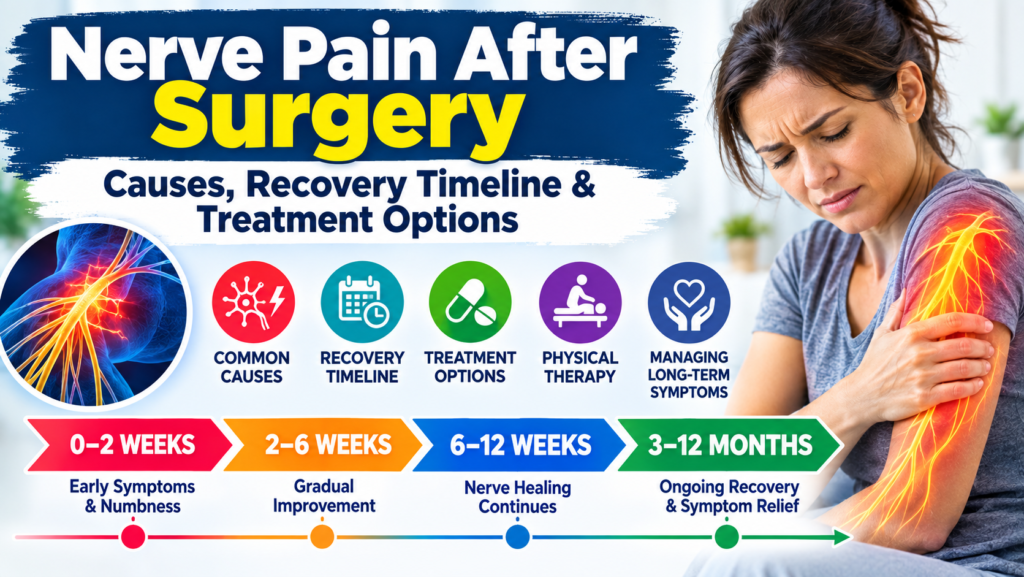
Nerve pain after surgery: recovery timeline
Because nerve recovery varies so much, a rigid week-by-week schedule can be misleading.
A more useful framework is:
Early recovery
Nerves may be irritated following surgery.
Burning, tingling or shooting sensations can occur depending on the procedure.
Intermediate recovery
Symptoms may fluctuate with activity and rehabilitation.
A gradual reduction in symptoms is generally more reassuring than progressive worsening.
Later recovery
Persistent nerve symptoms should be reassessed if they continue beyond the expected recovery period.
Beyond three months
Pain lasting more than three months meets the Canadian definition of chronic pain and warrants appropriate clinical assessment rather than simply being assumed to be normal postoperative discomfort. (Canada)
Can nerve pain go away completely after surgery?
Sometimes.
The outcome depends on:
- What caused the nerve problem
- Whether the nerve was compressed or injured
- The severity of any nerve injury
- The operation performed
- Your underlying health
- How the nerve responds during recovery
Some patients experience complete improvement.
Others have residual symptoms.
Persistent symptoms do not necessarily mean that nothing can be done. Canadian pain resources emphasize individualized and multimodal approaches to pain management. (Canada)
The Bottom Line
Nerve pain after surgery can feel very different from ordinary postoperative soreness. Burning, shooting, tingling, electric-shock sensations, numbness and unusual sensitivity can all occur with neuropathic pain.
Some nerve symptoms improve as irritated nerves recover, and Canadian surgical guidance notes that this process can take weeks or longer in some situations. (University Health Network)
If symptoms are progressively worsening, spreading, associated with new weakness or significant numbness, or interfering with your ability to function, contact your healthcare provider.
If you experience sudden major weakness, paralysis, new bladder or bowel problems, numbness around the groin, or another serious neurological change, seek emergency medical attention.
For Canadians living with persistent pain, Health Canada’s resources also provide information about provincial and territorial pain-management services and other support options. (Canada)
Frequently Asked Questions
What helps nerve pain in the legs after back surgery?
Treatment depends on why the nerve is painful. Following the surgeon’s activity restrictions, appropriate rehabilitation, physiotherapy and clinician-directed pain treatment may help. UHN notes that burning, tingling and shooting leg symptoms can occur while nerves recover after certain spinal procedures. (University Health Network)
How long does nerve pain last after surgery?
There is no universal timeframe. Some symptoms improve during the early recovery period, while nerve irritation can persist for weeks or longer depending on the procedure and the underlying nerve problem. Persistent or worsening symptoms should be assessed.
Is burning pain normal after surgery?
Burning can be a characteristic of neuropathic pain. It can occur when nerves are irritated or affected during recovery. Burning pain that is worsening, spreading or associated with numbness or weakness should be discussed with a healthcare professional.
Is tingling after surgery normal?
Temporary tingling can occur after some operations, particularly when nerves have been irritated. However, new or worsening tingling accompanied by significant numbness, weakness or loss of function requires medical assessment.
Why do I have shooting pain after surgery?
Shooting or electric-shock-like pain can occur when nerves are irritated or affected. It may be postoperative nerve pain, but the cause depends on the operation and your symptoms.
Can nerve pain get worse before it gets better after surgery?
Symptoms can fluctuate during recovery, including with changes in activity. However, persistent or progressive worsening should not automatically be considered normal. Contact your surgical team if symptoms continue to worsen.
What medication is used for nerve pain after surgery?
Depending on the cause, clinicians may consider medicines used specifically for neuropathic pain, including certain antidepressants or anticonvulsant/antiseizure medicines. The appropriate medication depends on the individual and should be determined by a healthcare professional. (MyHealth Alberta)
Can physiotherapy help nerve pain after surgery?
Physiotherapy may help some patients improve movement, strength and function and can form part of a broader pain-management plan. The appropriate exercises depend on the operation and stage of recovery. (MyHealth Alberta)
Can nerve pain after surgery become permanent?
It can persist in some people, but postoperative nerve symptoms do not automatically indicate permanent nerve damage. The outcome depends on the cause and severity of the nerve problem and how it responds to treatment.
When should I worry about nerve pain after surgery?
Seek medical advice when pain is progressively worsening, new numbness or weakness develops, symptoms spread, walking becomes difficult, or pain significantly interferes with daily activities.
When is nerve pain after surgery an emergency?
Sudden major weakness, paralysis, new loss of bladder or bowel control, numbness around the groin or inner thighs, sudden inability to walk, or severe neurological deterioration requires urgent medical assessment.
Editorial
Recommended reviewer
For publication, use a named Canadian physician, neurologist, anaesthesiologist, orthopaedic surgeon, neurosurgeon, pain specialist or physiotherapist, depending on the article’s final scope.
Medically reviewed by: [Canadian-qualified medical professional]
Written by: [Named healthcare writer]
Last reviewed: September 8, 2026
Jurisdiction: Canada
Recommended Canadian sources
The primary references for this article should include:
- Health Canada — About Chronic Pain — useful for Canada’s definition of chronic pain and post-surgical pain. (Canada)
- Canadian Pain Task Force — useful for definitions of neuropathic pain and Canadian pain-management approaches. (Canada)
- HealthLink BC — Neuropathic Pain — useful for symptoms and general management. (MyHealth Alberta)
- University Health Network — Toronto — useful for nerve pain descriptions and postoperative spinal-surgery guidance. (University Health Network)
- MyHealth Alberta — useful for Canadian patient-facing information about neuropathic pain, nerve symptoms and treatment. (MyHealth Alberta)
- Health Canada — Chronic Pain Resources — useful for Canadian provincial/territorial resources and pain-management services. (Canada)
Internal Linking Strategy
Parent pillar
Pain After Surgery/pain-after-surgery/
Related cluster pages
Link naturally to:
- Pain After Hernia Surgery
- Pain After Rotator Cuff Surgery
- Pain After Hip Replacement
- Pain After Ankle Surgery
- Pain After Spinal Fusion
- Pain After Knee Surgery
- Pain After Cataract Surgery
- Pain After Colostomy Surgery
The strongest contextual links should be from sections discussing nerve pain after back surgery, hip surgery, knee surgery, and ankle surgery.
The primary search intent is:
Understanding why nerve pain occurs after surgery, how recovery progresses, what treatment options exist, and when symptoms require medical assessment.
Next in the sequence: Article #6 — “Pain After Ankle Surgery: Recovery Timeline & Pain Management.”